

 Aimie
Aimie
If you have spent any time trying to get your website noticed, you already know the rules of traditional SEO (Search Engine Optimization). For over two decades, the playbook has remained relatively steady: you target specific keywords, optimize your website’s page-loading speed, and build external links to convince Google’s algorithm that your site deserves to be on page one.
But user behavior is shifting rapidly. Millions of consumers are bypassing traditional lists of search links entirely. Instead, they are taking complex, conversational questions directly to conversational search engines and AI models.
When a consumer types a specific question like, "What’s the best boutique children’s clothing store in Europe that uses organic cotton and offers fast international shipping?", they don’t get a page of ten blue links. They receive a single, synthesized, conversational paragraph that actively recommends and cites three or four specific brands.
Getting your small business featured inside that AI-generated response is called GEO (Generative Engine Optimization).
The Practical Breakdown: How They Compare
To understand how to position your website, it helps to see how traditional search optimization compares to AI-first optimization side-by-side:
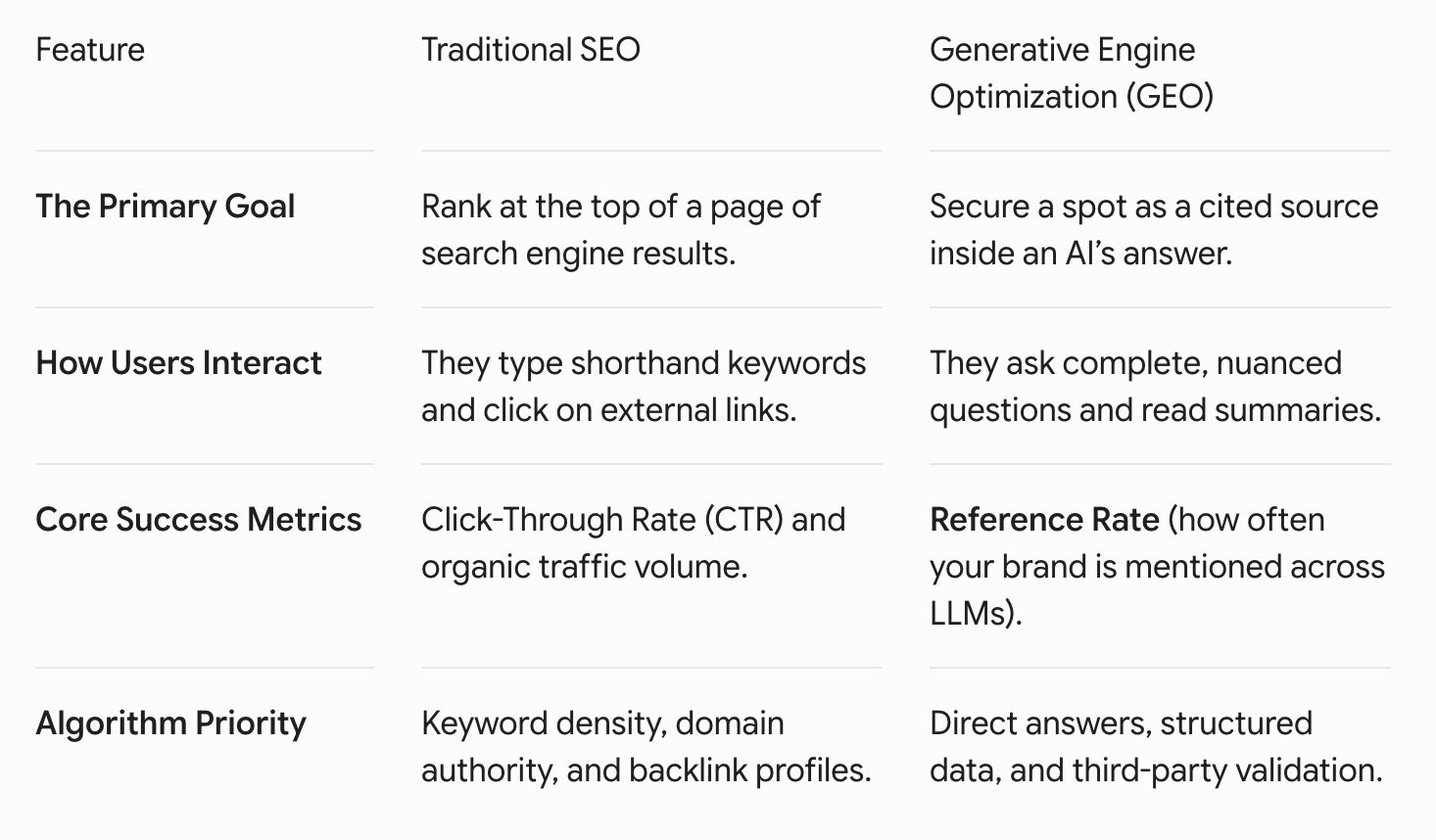
Why Small Businesses Can't Ignore GEO
A major benchmark study on GEO optimization techniques revealed a massive shift: AI models do not create endless lists. Where Google traditionally displays dozens of options across search pages, tools like ChatGPT or Perplexity may only mention two or three.
However, the same research showed that businesses implementing specific GEO optimizations saw their visibility in AI-generated answers increase by 30% to 40%.
For a small business, this means winning a slot in an AI answer is a massive shortcut. You no longer have to out-fund a massive corporation’s SEO budget to get noticed; you just have to be the most clear, accurate answer to the user's specific problem.
Action Plan: How to Optimize Your Website for GEO
Winning at GEO does not mean throwing away your current SEO efforts. According to Google's Official AI Optimization Guide, foundational SEO best practices - like clear site structures and fast mobile performance - are exactly what AI crawlers look for.
To turn your website into an ideal source for large language models (LLMs), implement these three practical adjustments:
1. Structure Content Using the "Answer-First" Framework
AI models harvest information in modular chunks. If a blog post or service page is filled with fluffy, overly promotional introductions, an AI scraper will likely skip it.
- The Tactic: Structure your subheadings as direct questions your customers actually ask. Then, ensure the first 40 to 60 words immediately following that subheading give a clear, confident answer. Use summary phrases like "The main takeaway is..." or "Our service solves this by...", which AI filters look for when pulling quotes.
2. Implement Deep Local and Organizational Schema Markup
AI needs absolute certainty that your business is real, active, and local. It achieves this by reading your site's "Schema markup"—invisible code that tells search engines exactly what your data means.
- The Tactic: Ensure your website CMS has native or plugin-based Schema enabled for Organization and LocalBusiness. This code should explicitly state your exact business name, physical address, phone number, and operating regions. Keeping this data identical across your website and your Google Business Profile gives AI engines the confidence to recommend you for local queries.
3. Build a Third-Party Verification Footprint
AI engines don't just trust what you say about yourself; they actively cross-examine your reputation by scanning customer reviews on platforms like Trustpilot, Yelp, and Google.
- The Tactic: Regularly encourage your clients to leave highly specific reviews. An AI reading a review that says, "Their customer service helped me pick the right size for my child instantly" teaches the model to associate your entity with terms like "helpful customer service" and "accurate sizing."
The Takeaway: SEO ensures your digital storefront is visible to traditional web surfers, while GEO places your brand directly into the conversations consumers are having with AI. Implementing these small tweaks keeps your business ahead of the curve as search behavior continues to evolve.